
21Sep
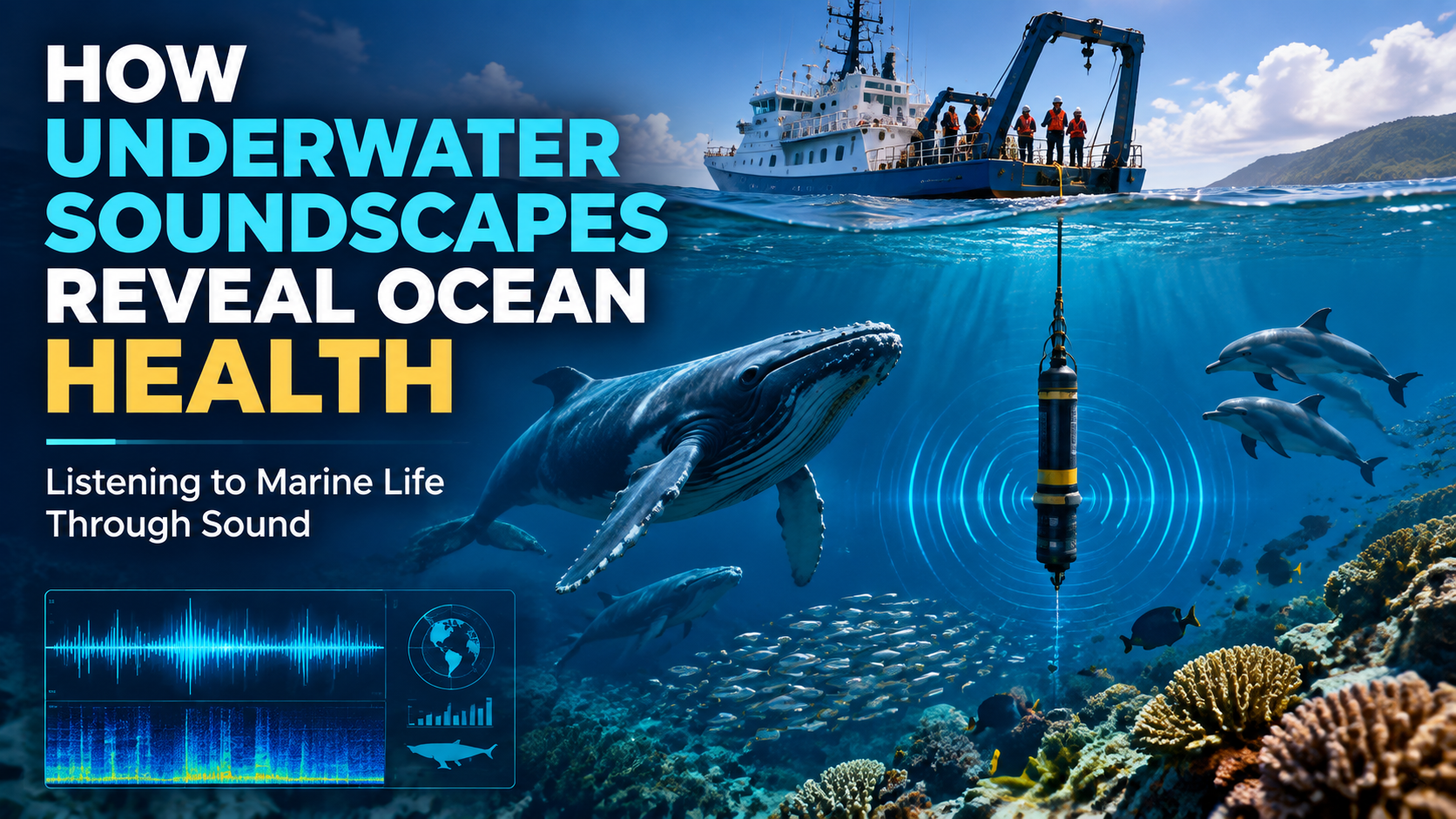
How Underwater Soundscapes Reveal Ocean Ecosystem Health
The ocean is filled with sounds that humans rarely hear. From whale songs traveling across vast
distances to tiny organisms creating underwater vibrations, marine environments produce a
complex acoustic world.
Scientists study these sounds through underwater soundscapes, collections of natural and
human-made noises recorded beneath the surface. These recordings help researchers
understand marine animals, identify ecosystem changes, and monitor the effects of human
activity on ocean environments.
Instead of relying only on visual observations, scientists can “listen” to the ocean to gather
information about habitats that are difficult to access.
What Are Underwater Soundscapes?
An underwater soundscape is the combination of all sounds present in a marine environment.
These sounds come from three major sources:
● Biological sounds from animals
● Physical sounds from natural processes
● Human-made sounds from ships, construction, and industrial activity
Marine animals use sound for communication, navigation, hunting, and finding mates. Whales,
dolphins, fish, and even some small marine organisms depend on acoustic signals to survive.
By studying these sound patterns, researchers can learn what species are present and how
ecosystems are changing.
How Scientists Record Ocean Sounds
Scientists use specialized underwater microphones called hydrophones to capture sounds
below the surface.
Hydrophones work similarly to microphones on land, but they are designed to operate
underwater and withstand pressure, saltwater exposure, and long-term deployment.
The recording process usually involves:
1. Placing hydrophones in selected ocean locations.
2. Recording sounds over hours, days, or months.
3. Analyzing audio data with specialized software.
4. Identifying patterns linked to animals or environmental conditions.
This method is known as passive acoustic monitoring because researchers collect information
without actively disturbing the environment.
Why Sound Is Important for Studying Marine Life
Many ocean animals are difficult to observe directly. Deep waters, darkness, and large migration
areas make traditional surveys challenging.
Sound provides another way to study marine populations.
For example:
● Whale calls can reveal migration routes.
● Dolphin sounds can indicate social behavior.
● Fish sounds can provide clues about spawning activity.
● Reef sounds can help researchers assess habitat conditions.
Underwater soundscapes allow scientists to collect information continuously, even when
animals are hidden from cameras or underwater vehicles.
Using Sound to Measure Ecosystem Health
A healthy ecosystem often has a diverse range of sounds. Different species create different
acoustic patterns, forming a unique signature for each environment.
Researchers analyze these patterns to understand biodiversity and ecosystem changes.
A decrease in certain sounds may indicate changes such as:
● Reduced animal populations
● Habitat damage
● Increased human disturbance
● Changes in environmental conditions
An increase in artificial noise may also affect marine animals. Ships, drilling operations, and
construction can create underwater noise that interferes with communication and behavior.
The Impact of Human Noise on the Ocean
The ocean has become increasingly affected by human-generated sounds.
Shipping traffic, offshore energy projects, and coastal development contribute to underwater
noise pollution. Some marine animals rely heavily on hearing, making them especially sensitive
to these changes.
Scientists study acoustic environments to understand how noise affects:
● Animal communication
● Feeding behavior
● Migration patterns
● Stress responses
By identifying areas with high noise levels, researchers can support strategies that reduce
disturbances and protect important habitats.
The Role of Technology in Ocean Listening
Modern technology has transformed how scientists study marine sounds.
Advanced recording equipment can collect large amounts of data for extended periods.
Computer analysis tools help researchers identify animal calls and compare changes over time.
Artificial intelligence and machine learning methods are increasingly used to process recordings
because ocean audio datasets can contain thousands of hours of information.
Organizations such as Oceanography provide educational resources about marine research,
exploration, and ocean science.
How Sound Helps Discover Hidden Ocean Life
Many marine discoveries begin with unusual sounds.
Researchers have identified species presence by detecting calls before observing animals
visually. In remote areas, acoustic monitoring can reveal biodiversity patterns that would
otherwise remain unknown.
For example, a hydrophone network can detect seasonal changes as different species arrive
and leave an area.
This makes sound an important tool for studying oceans that are too large and complex to
monitor through direct observation alone.
The Future of Ocean Sound Research
As technology improves, scientists will continue expanding the use of acoustic monitoring.
Future research may include larger networks of underwater sensors, improved automated
sound recognition, and long-term monitoring programs that track ecosystem changes over
decades.
The information collected from underwater soundscapes can help researchers understand how
oceans respond to climate change, human activity, and conservation efforts.
Conclusion: Learning From the Ocean’s Natural Voices
The ocean communicates through sound. Every whale call, fish signal, and environmental noise
provides information about what is happening beneath the waves.
By studying underwater soundscapes, scientists can monitor marine life, identify ecosystem
changes, and better understand the health of ocean environments.
Listening to the ocean does more than reveal hidden sounds. It provides a powerful way to
protect and study one of Earth’s most important ecosystems.
Explore more marine science insights through Oceanography.
FAQs
1. What are underwater soundscapes?
Answer: Underwater soundscapes are the complete collection of sounds found in marine
environments, including animal calls, natural ocean processes, and human-generated noises.
2. How do scientists record underwater sounds?
Answer: Scientists use hydrophones, underwater microphones designed to capture sounds in
oceans, lakes, and other aquatic environments. These devices can record marine activity for
long periods.
3. What is passive acoustic monitoring?
Answer: Passive acoustic monitoring is a research method that collects environmental sounds
without actively interacting with the ecosystem. It is widely used to study marine animals and
ocean conditions.
4. Can underwater sounds show ecosystem health?
Answer: Yes. Changes in acoustic patterns can provide clues about biodiversity, animal activity, habitat
changes, and the effects of human noise pollution.
5. What animals can scientists identify through sound?
Answer: Researchers can detect sounds from whales, dolphins, fish, crustaceans, and other
marine organisms. Different species often produce unique acoustic patterns.
6. How does ocean noise pollution affect marine animals?
Answer: Human-generated underwater noise can interfere with communication, navigation, and
behavior in some marine species. Researchers study these impacts to support conservation
efforts.
7. What equipment is used to study ocean sounds?
Answer: The main equipment includes hydrophones, underwater recording systems, data
storage devices, and software tools for analyzing acoustic information.
8. How do scientists analyze underwater recordings?
Answer: Scientists use acoustic analysis software to identify patterns, classify animal sounds,
measure noise levels, and compare recordings from different locations or time periods.
9. Where can I learn more about ocean research?
Answer: Resources from organizations such as NOAA Ocean Exploration provide information
about ocean exploration, marine technology, and scientific research methods.
